How White-Label Wedding Video Editing Works — And What Your Clients Actually See
- White-label is a delivery standard, not just outsourcing. Plenty of editors will cut your footage. The standard also means they stay off the file name, the review link, the metadata and the invoice.
- Your couple’s experience shouldn’t change at all. They book you, they hear from you, they review with you, and they get the film from you. The edit happens a layer down.
- Invisibility is mechanical, not a promise. Ten specific surfaces can leak a third party. Every one of them is checkable before you deliver.
- Revisions are where most arrangements break. If your couple’s notes reach your editor without passing through you, you have stopped being the studio.
- Ask about the editor, not the company. One named editor who keeps your account is the single best predictor that film twenty looks like film one.
- What white-label editing is
- White-label vs regular outsourcing
- How the handoff works, step by step
- What your clients actually see
- The ten places a third party can show up
- How revisions travel
- How long an edit takes
- What it costs, and what you charge
- When it isn’t the right fit
- Frequently asked questions
- How Eterna Edits answers this checklist
What is white-label wedding video editing?
- No credit anywhere. No watermark, no end slate, no “edited by”, no tag in the file, no mention on social.
- No contact with your client. The editor never emails your couple, never joins a call, never appears in a review thread.
- No claim on the work. The partner doesn’t post the film to their own portfolio or reel unless you specifically hand them permission.
White-label vs regular outsourcing: what’s the difference?
| Regular outsourcing | White-label | |
|---|---|---|
| Who your couple deals with | Sometimes the editor directly, for notes or file transfers | Only you, at every step |
| Whose name is on the film | Often shared, or the editor asks for a credit | Yours, and only yours |
| Portfolio rights | The editor usually wants to show the work | The film stays private unless you release it |
| How you buy it | Project by project, whoever is free | An ongoing account with the same editors |
| Style consistency | Varies with whoever takes the job | Held to a documented style guide across the season |
| Confidentiality | Informal, often nothing in writing | A business-to-business NDA covering footage, couples and your rates |
| Best for | One overflow wedding, a rescue job, a one-off format | A season of volume you intend to keep growing |
How does white-label wedding video editing work, step by step?
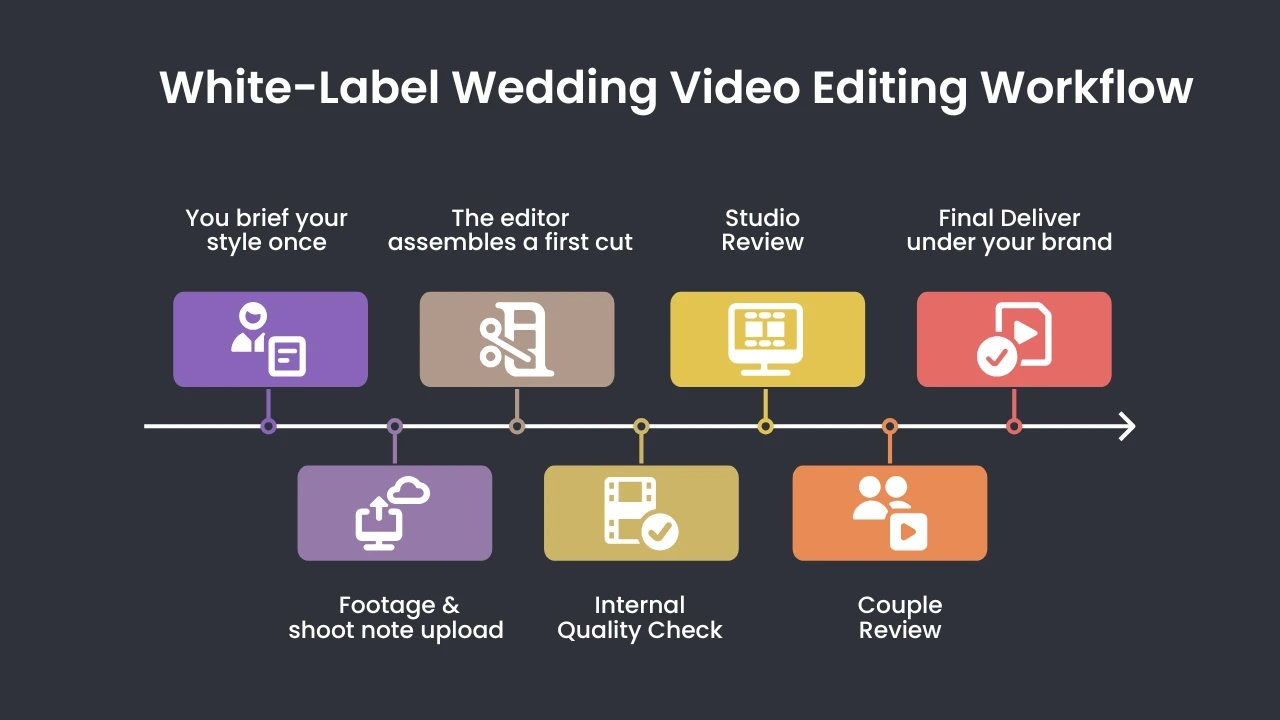
1
You brief your style once
2
You upload the footage and a shoot note
3
The editor assembles a first cut
4
The partner runs an internal check before you ever see it
5
You review it privately, as the studio
6
Your couple reviews — through you
7
You deliver the final film under your brand
What do your clients actually see?
| Touchpoint | What your couple sees | What’s actually happening |
|---|---|---|
| Booking and planning calls | You, as always | Unchanged — the partner isn’t involved before the wedding |
| The wedding day | You and your team shooting | Unchanged |
| After the wedding | Your “footage is safe, editing has started” note | You’re uploading the footage to your partner |
| Waiting for the first cut | Your timeline, communicated by you | The editor is working to an earlier internal deadline |
| First cut arrives | Nothing — they don’t see this stage | You’re reviewing it privately and sending notes |
| Their review link | Your review page, your logo, your domain | The file was exported by the partner and uploaded by you |
| Their revision notes | They send them to you | You translate and forward them to the editor |
| Final delivery | Your gallery or drive, your file names | Exported to your naming convention with clean metadata |
| The invoice | Your studio name and payment details | You’re billed separately by the partner |
| Social and portfolio | Your feed posting their film | The partner posts nothing without your permission |
The honest version: a couple who never sees a stray file name, a strange review domain or an unfamiliar email address has nothing to notice. The invisibility isn’t a promise your partner makes — it’s a result of the surfaces below being clean.
How do revisions travel without your couple meeting your editor?
- Batch the notes. Collect everything your couple wants in one list before sending anything to your editor. Drip-feeding three notes over five days burns your revision rounds and your turnaround.
- Know what counts as a revision. Adjusting a cut point is a revision. Changing the song, the film’s length or the story structure is usually a re-edit, and partners price those differently. Agree the line in writing before your first wedding.
How long does a white-label wedding edit take?
| Deliverable | Typical first cut | What moves it |
|---|---|---|
| Teaser or social reel | 24–48 hours | Whether you’ve pre-selected the clips |
| Highlight film (6–10 min) | 3–5 days | Footage volume, number of cameras, audio condition |
| Short film | 5–7 days | Story complexity, speech coverage |
| Full documentary edit | 7–14 days | Ceremony length, multicam sync, total runtime |
What does white-label wedding video editing cost, and what do you charge?
| Factor | Why it changes the price |
|---|---|
| Deliverable and runtime | A 90-second teaser and a two-hour documentary edit are different jobs entirely |
| Hours of raw footage | Culling is a real cost; twenty hours takes longer to watch than ten |
| Number of cameras and sources | Multicam sync, drone, and separate audio recorders all add setup time |
| Audio condition | Clean lav audio is fast; wind, echo and room noise are slow |
| Color complexity | Matching mixed cameras and mixed lighting takes longer than one camera in daylight |
| Number of deliverables | Highlight plus teaser plus vertical cuts plus full ceremony, priced as a bundle |
| Turnaround | Rush work carries a premium — one provider publishes +50% for 48–72 hours |
| Revision rounds included | More included rounds costs more up front and less in surprises |
Setting your own price on top
When is white-label editing not the right fit?
- Editing is your product, not your bottleneck. If couples book you specifically because of how you cut — not how you shoot — handing the edit away removes the thing they’re buying.
- You shoot fewer than about eight weddings a year. At that volume the setup cost of briefing, testing and managing a partner probably outweighs the time you get back. Edit them yourself.
- You can’t describe your own style yet. Newer filmmakers often haven’t settled on a look. No partner can hold a style that doesn’t exist, and outsourcing at this stage locks in someone else’s defaults as yours.
- Your margin can’t absorb it. If editing costs eat the difference between a profitable wedding and a break-even one, the answer is your pricing, not a partner.
Frequently asked questions about white-label editing
What is white-label wedding video editing?
White-label wedding video editing is a service where an outside editing studio cuts your wedding footage and you deliver the finished film under your own brand. The editor takes no credit, has no contact with your couple, and appears nowhere on the file, the review link or the delivery. It lets a studio take on more weddings without hiring in-house editors.
Can couples tell that an outside editor cut their film?
Not from the film or the delivery, provided the mechanical surfaces are clean. Your couple’s contact, review link, file names, metadata and invoice all carry your studio only. The places a third party actually becomes visible are technical — file naming, folder structure, review-link domains, file metadata and automated notification emails — and all of them are checkable before you deliver.
What is the difference between white-label editing and just outsourcing?
All white-label editing is outsourced, but not all outsourcing is invisible. Regular outsourcing may leave the editor visible to your client, asking for a credit or posting the work. White-label means no credit, no client contact and no portfolio claim, held by an NDA and an ongoing account rather than a one-off job.
How do I stop an outside editor from changing my style?
Write your style down before any footage moves, send two or three reference films with it, and pay for one test edit you judge against fixed criteria. Then ask for one named editor to keep your account rather than a rotating pool. Style drift usually starts the week the work is handed to a second editor who never saw your references.
How much does white-label wedding editing cost?
It varies with the deliverable, the footage volume and the turnaround. Published market figures for this kind of editing run roughly $50 to $500 per video, with monthly partner plans around $1,500 to $5,000 for set volume; wedding work sits at the upper end because of the footage volume and multicam audio involved. Ask for a quote on a specific wedding rather than working from a list price.
Who owns the footage and the finished film?
You do. Your partner processes your media on your behalf and holds no ownership of the raw footage or the final film. Settle it in writing anyway: an NDA naming the footage and your clients, a stated retention window, portfolio rights staying with you, and whether project files are included or charged extra.
How long does a wedding edit take with an outside partner?
First cuts typically run 24 to 48 hours for a teaser, three to five days for a highlight film, five to seven days for a short film and seven to fourteen days for a full documentary edit. Add your own review time and one revision round before you quote a couple, and ask specifically about capacity in your busiest months rather than the provider’s average.
Do I need an NDA with a white-label editing partner?
Yes, and it should be specific. A business-to-business NDA signed before any footage moves should name the raw media, your couples’ identities, your deliverables and your rates. Generic confidentiality wording in a terms page is weaker than a signed agreement that says what happens to your footage and when it is deleted.
Can an editing partner post my wedding film to their portfolio?
Not without your written permission. In a genuine arrangement the film stays private: no portfolio use, no social posting, no tagging the couple, no award submissions. Get this in writing before the first wedding rather than discovering the answer afterwards.
What happens if my couple asks for changes?
Their notes come to you, and you translate them into editing instructions for your partner. Batch everything into one list before sending it, and agree in advance where a revision ends and a re-edit begins — adjusting cut points is usually a revision, while changing the song, the length or the story structure is usually priced separately.
How Eterna Edits answers this checklist
| What this post told you to check | How Eterna Edits answers it |
|---|---|
| Credit and branding | No watermark, no end slate, no “edited by”, no logo bug. Exports come back in your naming convention, with the metadata fields blank. |
| Contact with your couple | None, ever. We never email your couple, never join a call, never appear on a thread — not even on CC. |
| Portfolio rights | Nothing is published, posted, tagged or entered for an award without your written release. The film stays yours. |
| The same editor each time | A named editor holds your account across the season, so film twenty matches film one. |
| Your style | You send a style guide and two or three reference films; we match pacing, grade and audio to them. Send your LUT and we will work to it. |
| Turnaround | Teaser 24–48 hours · highlight film 3–5 days · short film 5–7 days · full documentary edit 7–14 days. |
| Revisions | Three rounds included, so you can sell two to your couples and keep one in reserve. |
| Project files | Included — not an extra. You keep the ability to re-cut the film in two years when the couple asks for an anniversary version. |
| Footage security | NDA on request and encrypted transfer, covering the raw media and your couples’ identities. |
| What we can take | One to three cameras plus drone, up to 10–12 hours of raw footage, delivered 480p to 4K. |
Send one wedding before you commit a season
E
Eterna Edits Editorial Team