
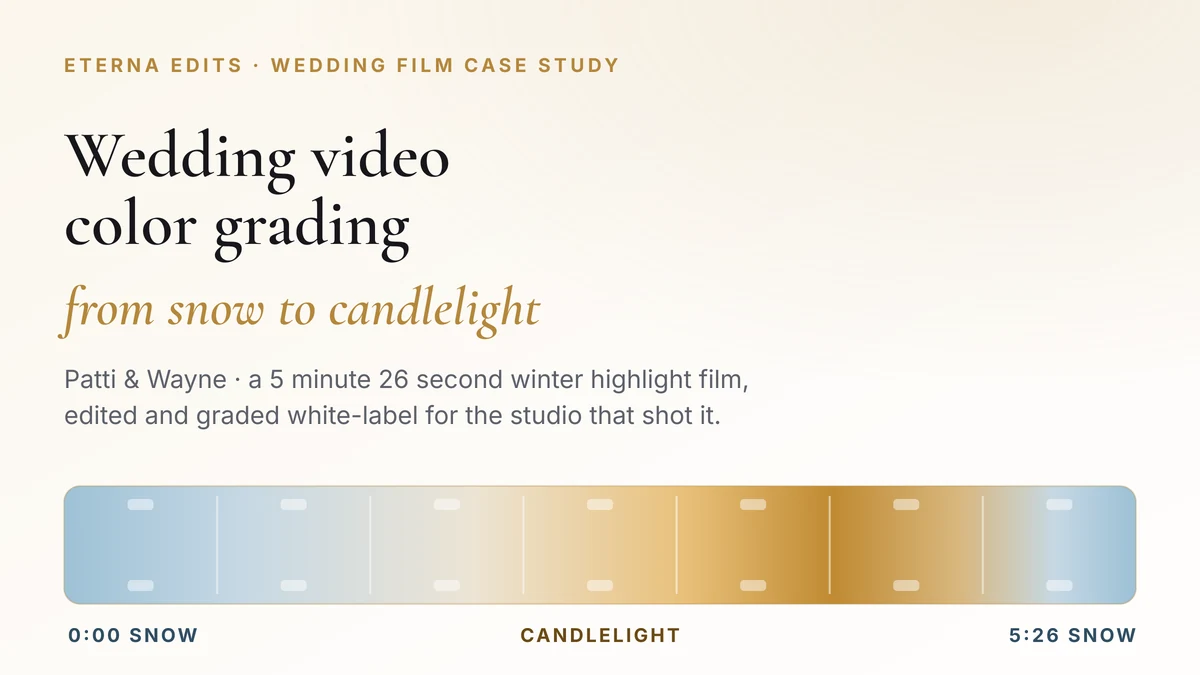
Patti & Wayne: Wedding Video Color Grading From Snow to Candlelight
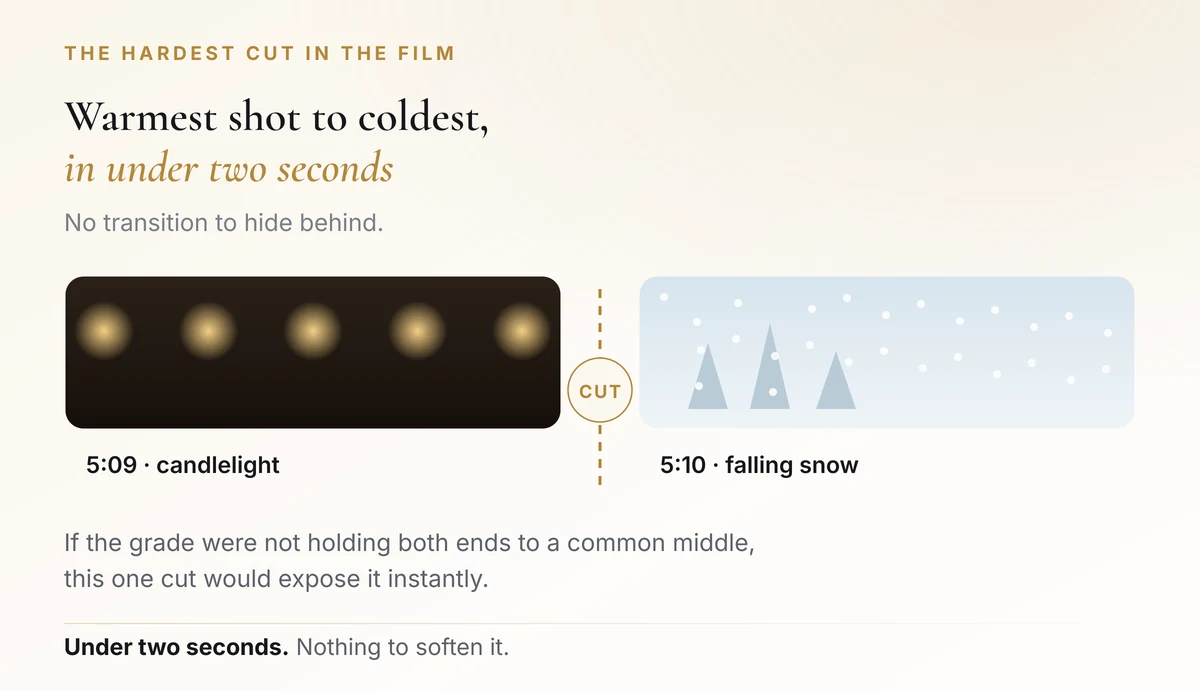
- In a highlight film, every color mismatch lands inside a single cut. There is nowhere to hide it.
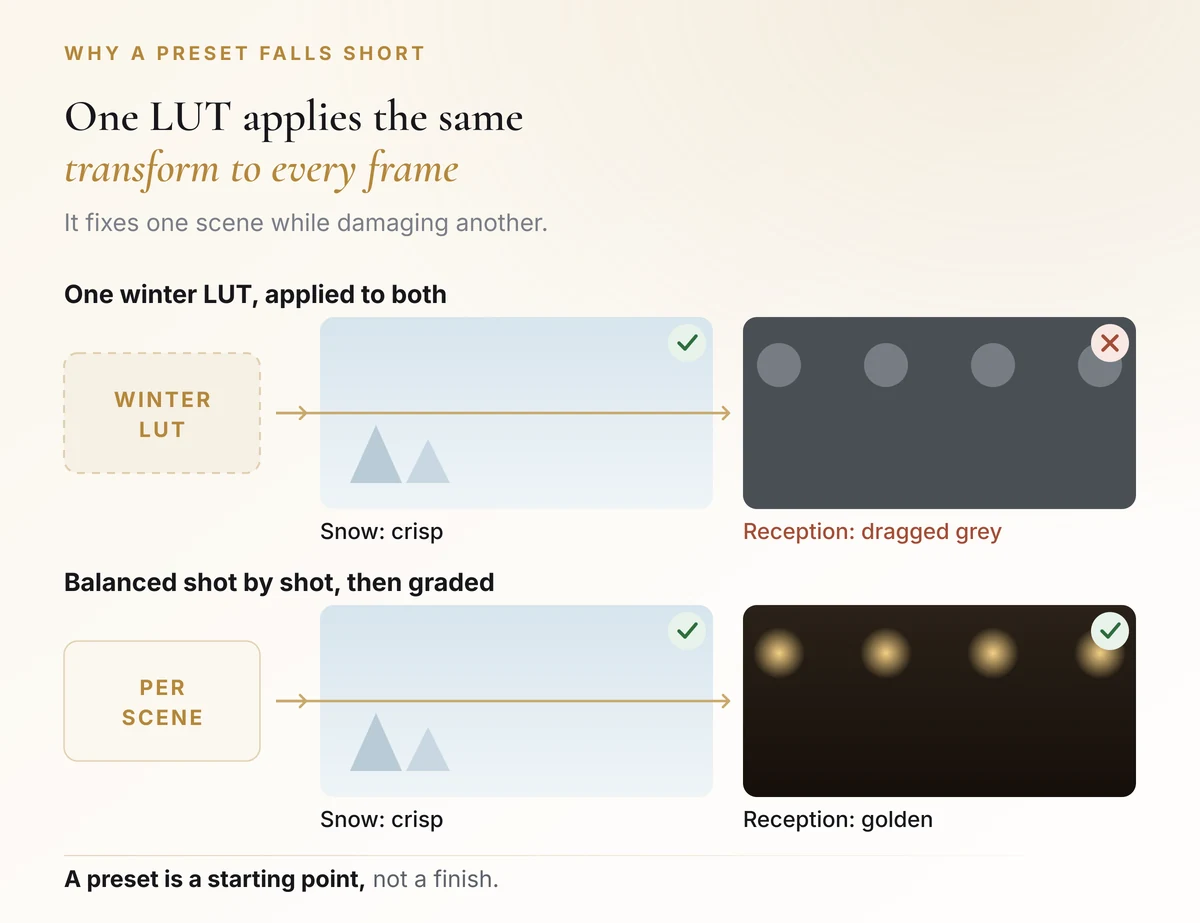
- Snow and candlelight sit at opposite ends of the exposure range — one winter LUT cannot serve both.
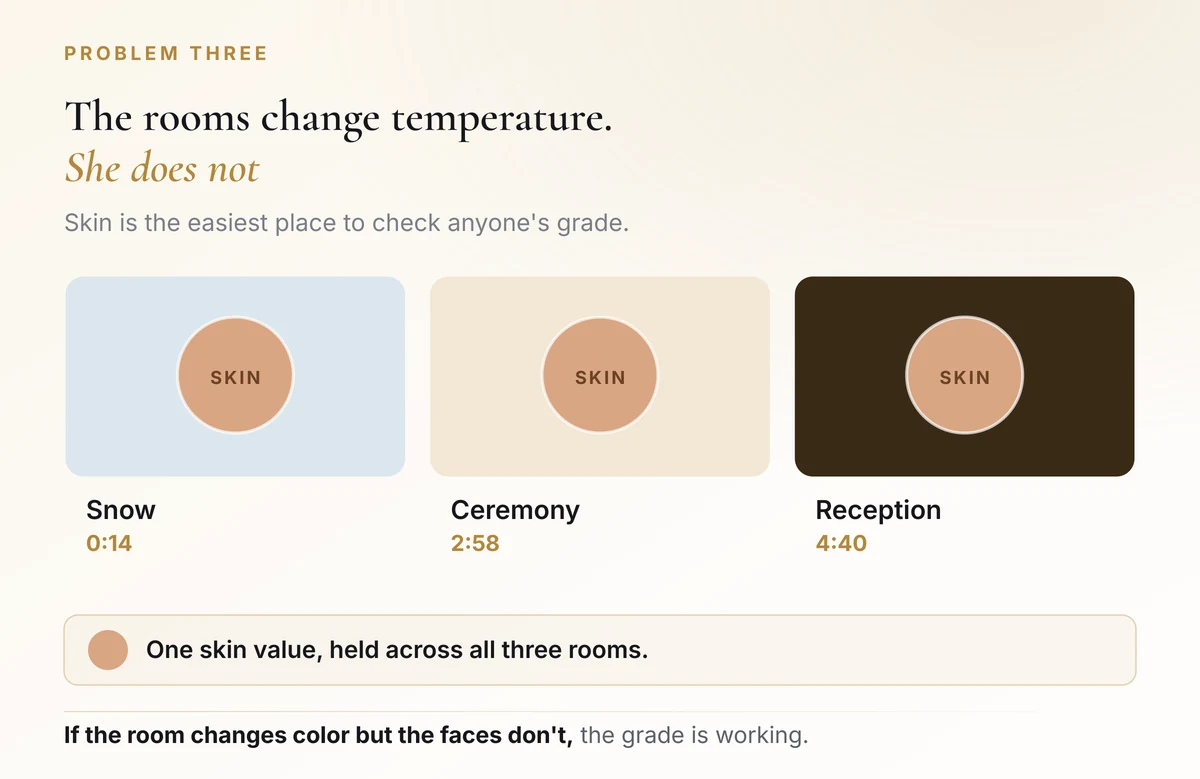
- The giveaway of a weak grade is skin: blue faces outside, orange faces inside.
- Eterna Edits delivers the full edit white-label, under your studio’s brand.
Watch the film first
- Film
- Wedding highlight film — Patti & Wayne
- Runtime
- 5 minutes 26 seconds
- Conditions
- Winter wedding, outdoor snow through to a candlelit indoor reception
- Work done
- Editing and color grading by Eterna Edits
- Delivered
- 4K master, white-label — no Eterna Edits branding anywhere in the film or the handover
- Service tier
- Highlight film, up to 6 minutes
- Client type
- Wedding videographers and studios in the United States
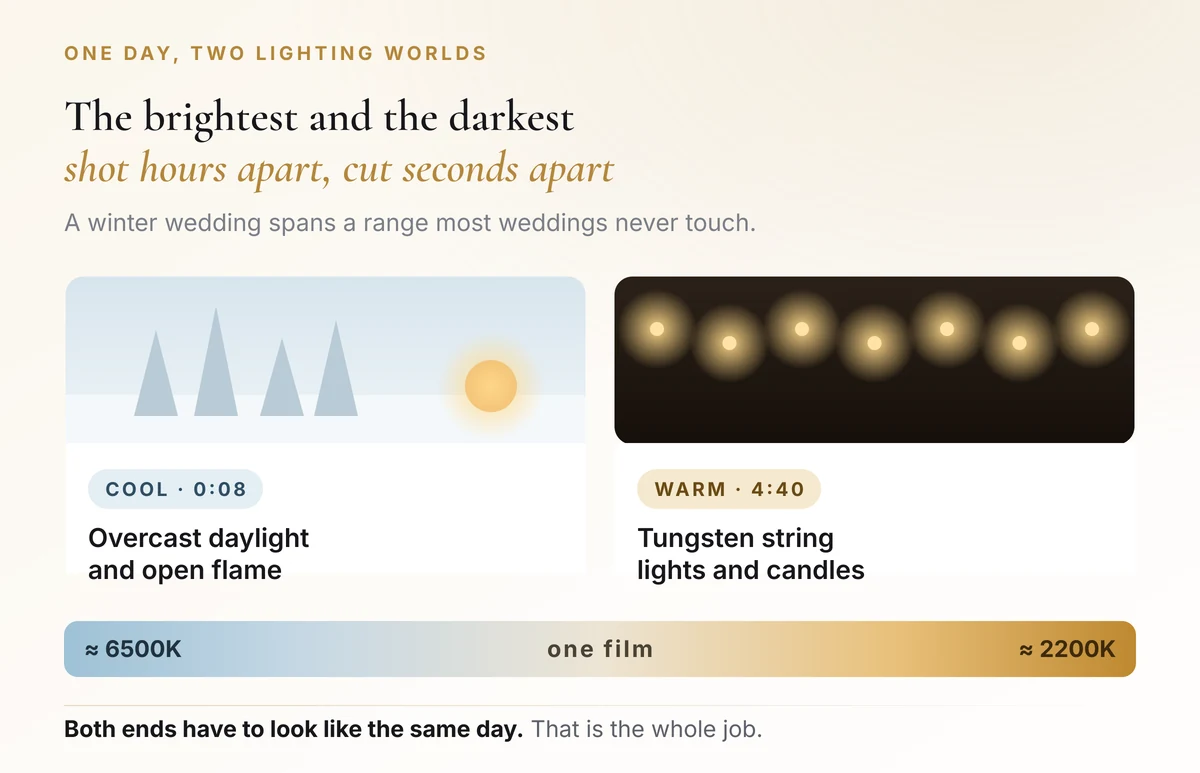
One day, two lighting worlds
| Approx. time | What’s on screen | Light source | The grading problem |
|---|---|---|---|
| 0:00 – 0:12 | Snowfield, pines, string lights, a burning fire pit | Overcast winter daylight plus open flame | Enormous brightness range in one frame |
| ~0:15 – 1:30 | First look at a stone-and-iron doorway; white gown, white fur wrap, navy suit | Window light, heavy snow bounce | White on white on white — almost no separation |
| ~1:30 – 3:30 | Ceremony at a wine-barrel altar, lanterns, live acoustic guitarist | Daylight through glass plus warm interior lamps | Two color temperatures inside a single shot |
| ~3:30 – 4:15 | Signing the register, champagne toasts | Warm interior | Carrying the look from cool to warm without a visible jump |
| ~4:15 – 5:10 | Barrel-room reception, first dance, champagne tower | Tungsten string lights plus candlelight | Low light, heavy amber cast, and the noise that comes with both |
| ~5:10 – 5:26 | Closing portraits in falling snow | Flat overcast daylight | The hardest cut in the film — straight from its warmest shot back to its coldest |
What the grade had to solve
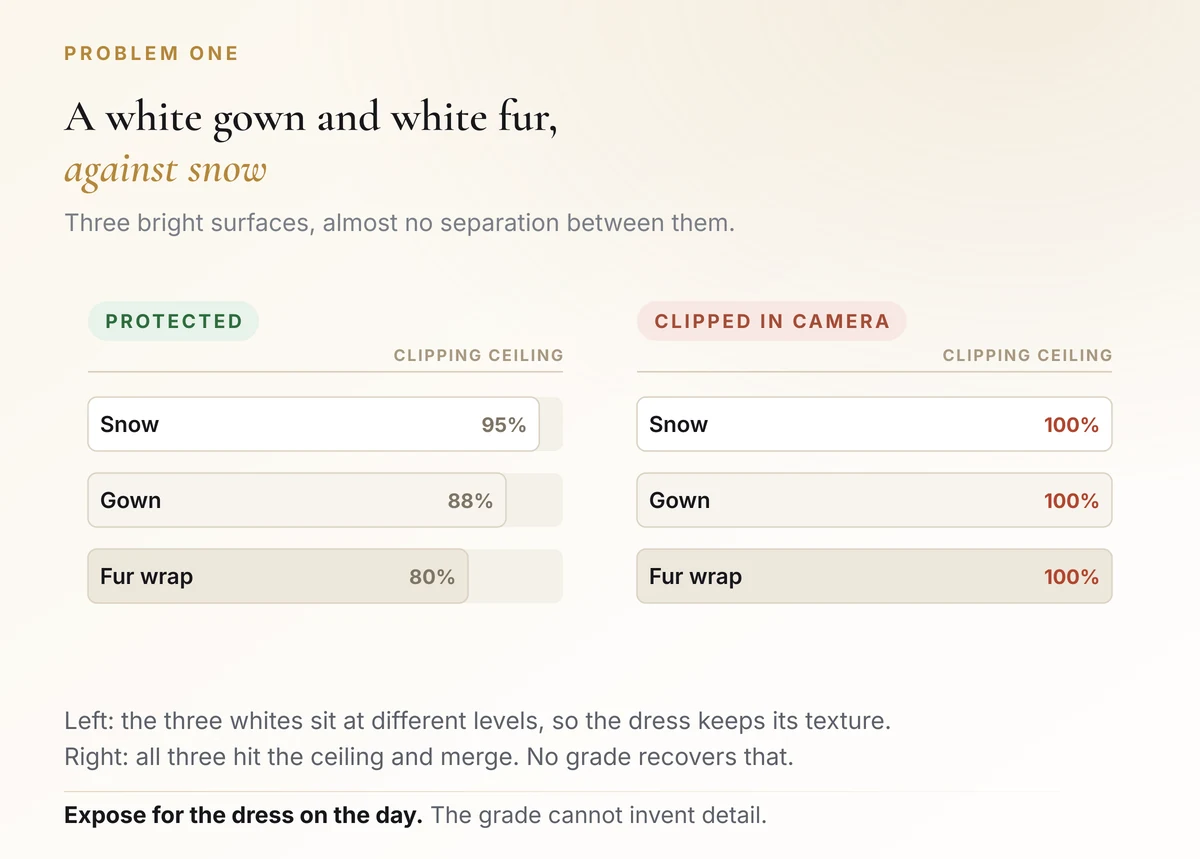
1. A white gown and a white fur wrap, against snow
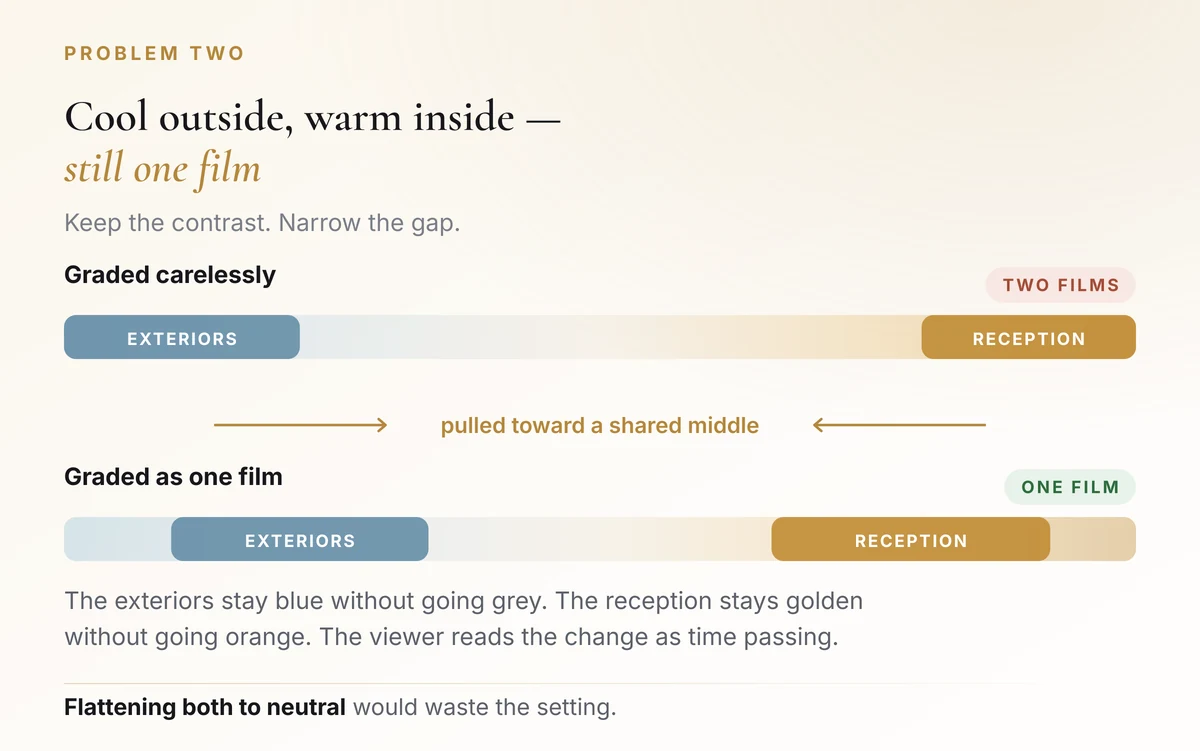
2. Cool outside, warm inside — one film
3. Skin tones that survive a winter grade
Why one winter LUT would not have done this
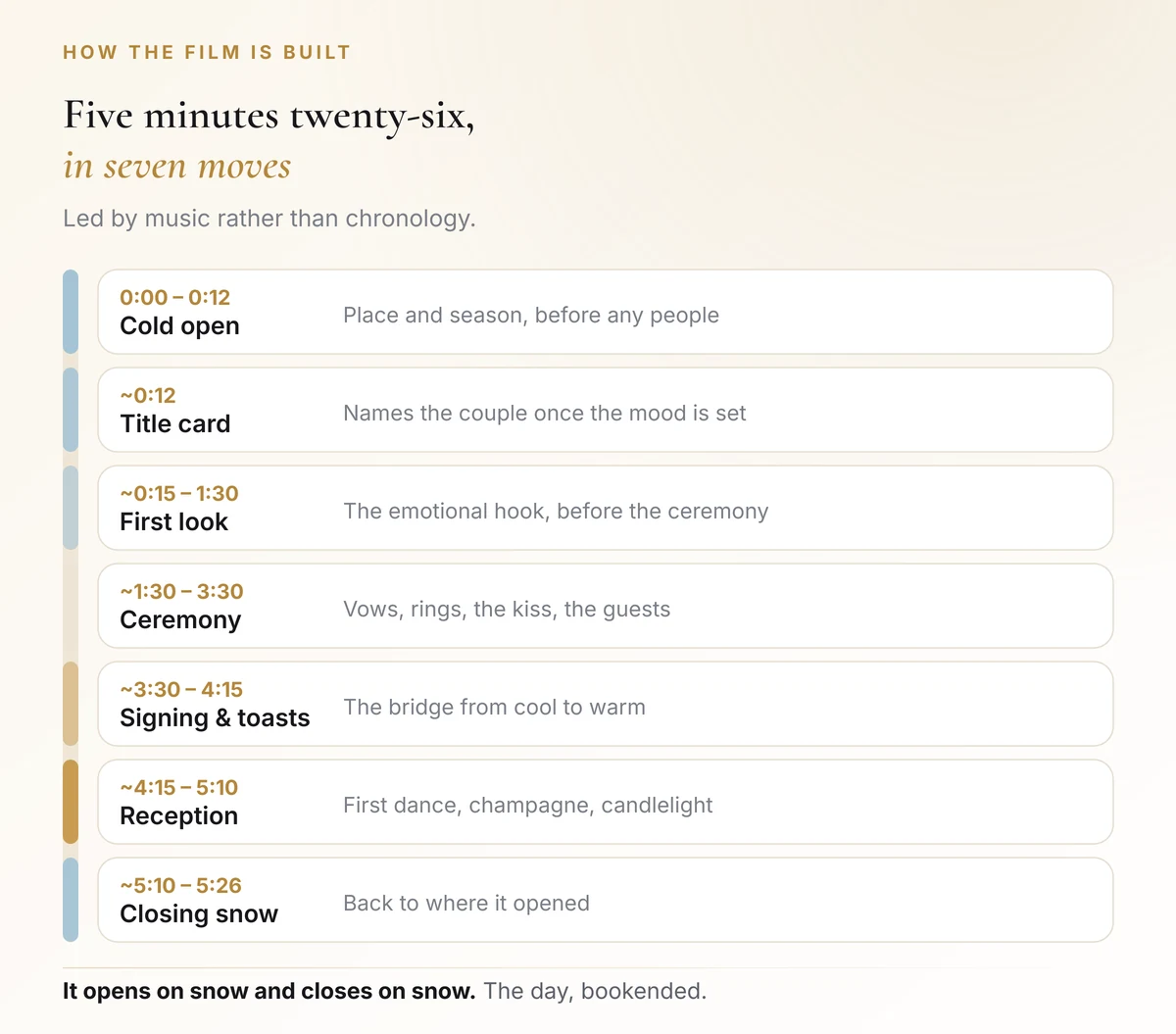
How the highlight film was built
| Approx. time | Segment | What it does for the story |
|---|---|---|
| 0:00 – 0:12 | Cold open | Establishes place and season before any people, so the viewer knows what kind of day this is |
| ~0:12 | Title card | Names the couple once the mood is already set |
| ~0:15 – 1:30 | First look | The emotional hook — reactions land hardest before the ceremony, not after |
| ~1:30 – 3:30 | Ceremony | The longest single block: vows, rings, the kiss, and the guests watching |
| ~3:30 – 4:15 | Signing and toasts | A deliberate breath, and the bridge that carries the grade from cool to warm |
| ~4:15 – 5:10 | Reception | Release: first dance, champagne tower, candlelight, movement |
| ~5:10 – 5:26 | Closing snow portraits | Returns to where the film opened — the quiet last image after the noise of the party |
The film ends where it began
What the studio received
- 4K master. Even when a couple only ever watches on a phone, a 4K master gives the studio room to reframe, crop vertical cuts for social, and re-export later without a second edit.
- Under five and a half minutes. Long enough to carry a full day’s arc, short enough that people finish it. Our guide on how long a wedding video should be covers the length question properly.
- White-label. No Eterna Edits branding anywhere in the film or the delivery, so the studio presents it as their own work — which is how all of our outsourced wedding video editing runs.
Frequently asked questions
What is wedding video color grading?
Wedding video color grading is the post-production pass that gives every clip in a wedding film one consistent look and mood. It happens after correction, which fixes exposure and white balance. Grading is what makes footage from different cameras, rooms and times of day feel like a single film rather than a folder of clips.
What is the difference between color correction and color grading?
Correction fixes what is wrong; grading decides how it feels. Correction brings each shot to an accurate, neutral baseline — right exposure, right white balance, cameras matched to each other. Grading then applies a deliberate look on top of that baseline. Correction always comes first, because a look applied over uncorrected footage just makes the inconsistencies more obvious.
Why does snow look blown out or grey in wedding footage?
Two different failures. Blown out means the snow was overexposed and clipped to pure white, losing all texture — that happens in camera and cannot be fixed later. Grey means the camera’s automatic metering saw a very bright scene and darkened it, which is correctable in post by lifting exposure and setting a proper white point. Exposing slightly brighter than the meter suggests, while watching your highlight warnings, avoids both.
How do you stop a white wedding dress losing detail against snow?
By protecting the highlight range first, then separating the whites. The gown, any fur or veil, and the snow are all bright but not identical in brightness. Careful highlight handling keeps those small differences intact so the dress holds its fabric texture and reads as distinct from the background. If the dress clipped in camera, nothing in the grade will bring the detail back, which is why it is worth exposing for the dress on the day.
How do you match cool outdoor footage with warm indoor footage in one film?
You keep the contrast but narrow the gap. Cool exteriors and warm interiors are what make a winter wedding look like winter, so flattening them to one neutral temperature wastes the setting. Instead both ends get pulled toward a shared middle: the exteriors stay blue without going grey, the interiors stay golden without going orange, and skin tones are held consistent across both so the viewer reads the change as time passing.
Can a winter LUT or preset do this on its own?
Not across a film that spans snow and candlelight. A LUT applies the same transform to every frame, so a preset built for crisp snow will push a warm candlelit reception toward grey and cool the skin tones there. Presets are a useful starting point once shots have been balanced individually, but on a wedding with several very different lighting conditions, a one-click look will fix one scene while damaging another.
How long should a wedding highlight film be?
Most wedding highlight films run between three and six minutes. Patti & Wayne’s is 5 minutes 26 seconds, which is long enough to carry the first look, ceremony, portraits and reception without padding, and short enough that viewers watch to the end. It is not a full record of the day — it is the short, music-led version the couple actually rewatches and shares.
Can you outsource wedding video editing and still keep your own branding on the film?
Yes — that is what white-label post-production means. Eterna Edits edits and grades the film, and delivers it with no Eterna Edits name, logo or watermark anywhere in the film or the handover, so the studio presents it as their own work. Patti & Wayne’s highlight film was delivered this way. For US videographers and studios, this is the usual arrangement: the couple only ever deals with the studio they booked.
Can Eterna Edits grade footage I shot myself?
Yes. That is the core of the service. Studios send raw footage and get back a finished, graded film carrying no Eterna Edits branding, ready to deliver under their own name. Grading can be booked on its own through our video color grading services, or as part of a full edit.
Why choose Eterna Edits for wedding highlight films
- Highlight films are the core work, not a sideline. The up-to-six-minute highlight is a defined tier, so the compression, music-led pacing and story selection this format demands are routine rather than improvised.
- Difficult lighting is the test worth setting. Snow, candlelight, mixed-temperature rooms and white-on-white dresses are where outsourced grades usually fall apart. This page shows that work frame by frame instead of asserting it.
- White-label by default. Nothing in the film or the handover carries Eterna Edits’ name. The studio delivers it under their own brand.
- You keep the project files. Three revisions and the project files are included, so the edit stays yours and can be reopened later by anyone.
- Built for real wedding volumes. Up to 10–12 hours of raw footage per project, mastered up to 4K.
- Footage is handled as confidential material. NDA on request and encrypted transfer.
Send us a wedding that fights you
E