
Footage security
Wedding Video Editing NDAs and Footage Security: What to Ask For
Almost every editor will say yes when you ask them to sign an NDA. Very few can tell you where your couple’s footage is stored, who else can open it, or when it gets deleted. Those are the questions that actually protect you — here they are, in order.
EternaEdits Editorial Team·Published ·16 min read
The short answer
A wedding video editing NDA is a signed promise that your editor will keep your couple’s footage private and will not share, publish or reuse it without your written permission. Most professional editors sign one on request. But an NDA on its own is only a promise — ask who else can open the files, where they are stored, when they are deleted, and whether the editor may use the film in their portfolio.
Key takeaways
- An NDA is a remedy, not a safeguard. It tells you what happens after something goes wrong. Footage security is what stops it going wrong in the first place. You want both, and most videographers only ask for the first.
- “Yes, we’ll sign an NDA” is not an answer. It costs an editor nothing to say. The useful questions are about storage, access, deletion and portfolio rights.
- Ask who else touches the file. Your editor may not be the only person who opens it. Subcontracted editors, assistants and shared cloud folders are normal in this business — and they should be named, not discovered.
- Get a deletion date in writing. “We delete on request” puts the work on you and means your footage sits on someone’s drive indefinitely until you remember to chase it.
- Check your own client contract too. If it doesn’t allow you to use outside help, an NDA with your editor doesn’t fix that — the gap is between you and your couple.
Why wedding footage needs more care than most client work
Wedding footage is personal in a way corporate work never is. It holds a couple’s private vows, guests who never agreed to be filmed, children, family speeches, and moments people assumed stayed in the room. That is why wedding footage confidentiality is a different problem from protecting a product video.
Think about what is actually on the cards you hand over. A ceremony where someone cried. A best man’s speech that mentions a divorce. A father who has since died. Guests who were filmed in the background and never signed anything.
Your couple gave that to you. They chose you, met you, and read your contract. They did not choose your editor, and in most cases they do not know your editor exists.
That is what makes wedding video editing privacy a different question from ordinary data security. You are not guarding commercial material that belongs to a company. You are guarding people — and some of them never agreed to be filmed at all.
That is the real reason this matters. The risk is not usually a dramatic data breach. It is much more ordinary: a clip posted to an editor’s Instagram as a work sample, a public download link that never expired, a file still sitting in a shared folder two years later. None of those need a hacker. They just need nobody to have set a rule.
The short version: you are not protecting a file. You are protecting a promise you made to two people who trusted you with the most personal day of their lives.
What a wedding video editing NDA actually covers
A wedding video editing NDA normally covers four things: that the footage stays confidential, that it is used only to complete your edit, that it is not shared with anyone outside the agreement, and that it is returned or deleted when the job ends. Anything beyond that has to be written in.
Most NDAs you will be offered are short, one-way documents. One-way means the duty runs in one direction: your editor promises to protect your material, and you promise nothing in return. That is the right shape for this relationship.
A workable wedding video editing NDA should name:
- What counts as confidential. Not just the final film — the raw footage, the audio, the project files, your client’s names, and the wedding date and venue.
- What the editor may do with it. Open it, edit it, and deliver it back. Nothing else.
- Who else may see it. Either nobody, or a named list of people bound by the same terms.
- What happens at the end. A deletion or return obligation with an actual date attached.
- How long the duty lasts. Confidentiality should outlive the project. A term that expires when you get your film back protects nothing.
If you are starting from nothing, a general video editing NDA template is a reasonable base — but read it for the four points above, because most generic templates were written for corporate footage and say nothing about portfolio use, which is the clause that matters most in wedding work.
Why an NDA alone is not footage security
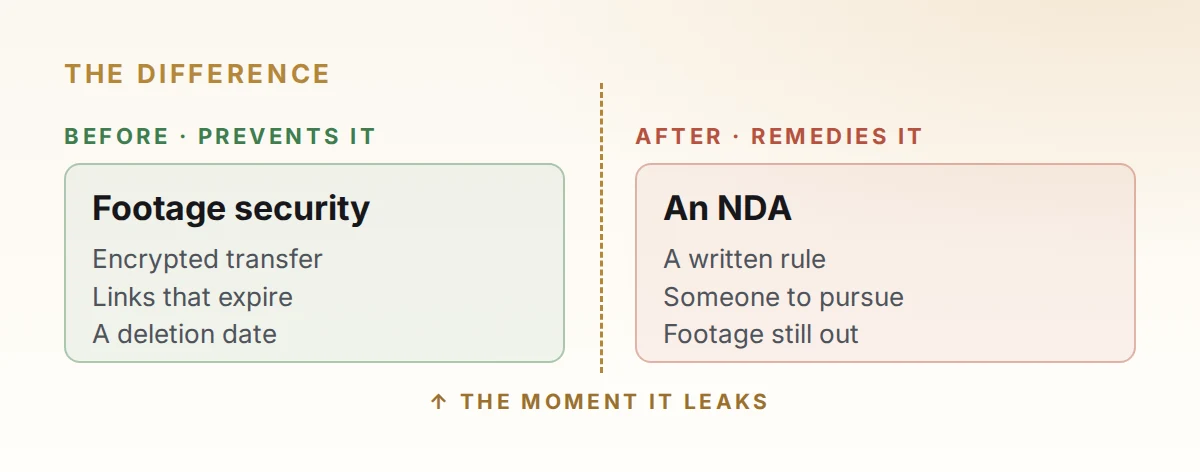
An NDA is a legal remedy, not a technical safeguard. It gives you something to enforce after footage has leaked. It does nothing to stop the leak. Real footage security comes from how files are moved, where they are stored, who can open them, and when they are destroyed.
This is the distinction almost every article on this subject skips, and it is the one worth holding on to.
Picture the worst case. Your couple’s ceremony ends up somewhere public. You have a signed NDA. What does it actually give you? The right to complain, and in theory the right to sue someone who may be in another country and may have no money. Meanwhile the footage is still out there, your couple has already seen it, and your reputation has already taken the hit.
The NDA did its job. It just turns out that job was never prevention.
So ask for the NDA. Then keep asking, because the next eight questions are the ones that change what actually happens to your files.
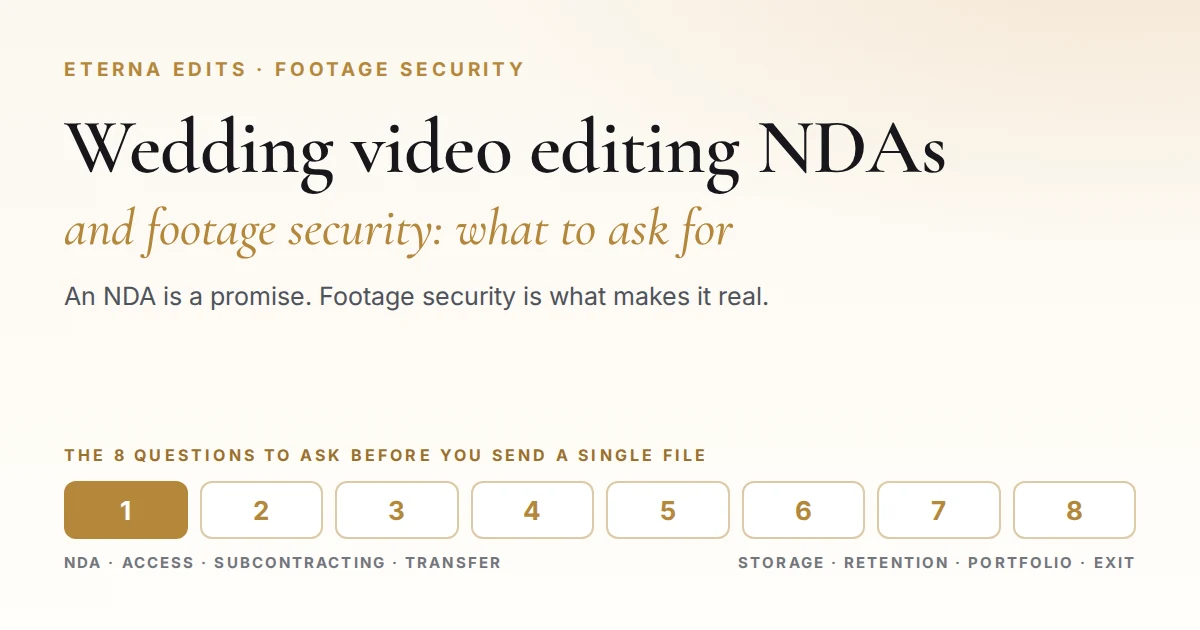
The 8 questions to ask before you send any footage
Before you send a single file, ask your editor these eight questions. A professional will answer all of them quickly and in writing. Hesitation on any one of them is useful information.
Send these by email, not over a call. You want the answers in writing, and you want to be able to re-read them next season.
| Ask this | What a good answer sounds like |
|---|---|
| 1. Will you sign my NDA, or do you have your own? | Either is fine. What matters is that it happens before you send footage, not after. |
| 2. Who, by name or role, will open these files? | A specific answer — "your editor and one quality-control reviewer, both employed by us" — not "our team." |
| 3. Do you ever subcontract editing to anyone outside your company? | A straight yes or no. If yes, they should name who, and confirm those people are under the same confidentiality terms. |
| 4. How will I send the footage, and how will you send it back? | An encrypted transfer with a password-protected, expiring link. Not a public link that lives forever. |
| 5. Where is the footage stored while you work on it? | A named location — their own servers, or a named cloud service with access limited to the people in question 2. |
| 6. When exactly is it deleted, and does that include backups? | A date or a window — "90 days after final delivery, including backups." Not "on request." |
| 7. May you use any part of this film in your portfolio or on social media? | "Only with your written permission, per project." Anything vaguer than that is a no. |
| 8. What happens to my footage if you close, or if my editor leaves? | A named handover or return process. Most editors have never been asked this and it is worth seeing how they react. |
Why question 8 matters
It is the one nobody prepares for. An editor who has thought about what happens to your files when their business ends has thought about the whole lifecycle — and that tells you more than any certificate.
Who else will see your wedding footage?
Usually more people than you assume. Beyond your named editor, a wedding file may be opened by a quality-control reviewer, a colorist, an assistant who organizes footage, and anyone with access to the shared folder it sits in. None of that is wrong. It only becomes a problem when it is undisclosed.
Editing studios divide work up, exactly like you do on a shoot. One person syncs the angles, another cuts, someone else checks the export before it goes out. That is how you get consistency.
The question is not “does anyone else touch this?” It is “who, and are they bound by the same terms?“
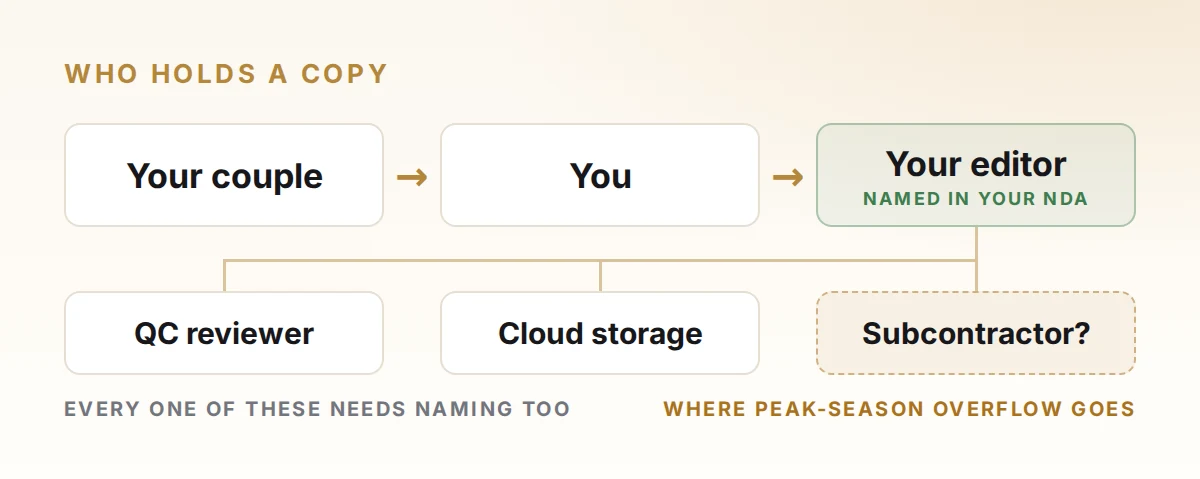
Pay particular attention to subcontracting. Some editing companies pass work to freelancers during peak season when their own capacity runs out. There is nothing inherently wrong with it — but if your NDA names only the company, and the company hands your couple’s wedding to an unnamed freelancer, your agreement has a gap in it exactly where you did not want one.
Ask directly, and ask in writing. If the answer is yes, the follow-up is simple: are they under the same confidentiality terms, and will you tell me when it happens?
Where is the footage actually processed?
Worth asking as well, because plenty of editing studios run sales in one country and editing in another. That is normal and it is not a problem in itself — a studio with staff editors abroad is often more controlled than a local freelancer working alone off a laptop in a coffee shop.
What matters is whether they tell you. A studio that names its locations up front has thought about the question. One that gets vague when you ask it has not. Eterna Edits, for example, states plainly that sales operate from Kalispell, Montana and editing is done at its studio in Ahmedabad, India — it is on the terms page, not buried in a reply.
How long does a video editor keep your footage?
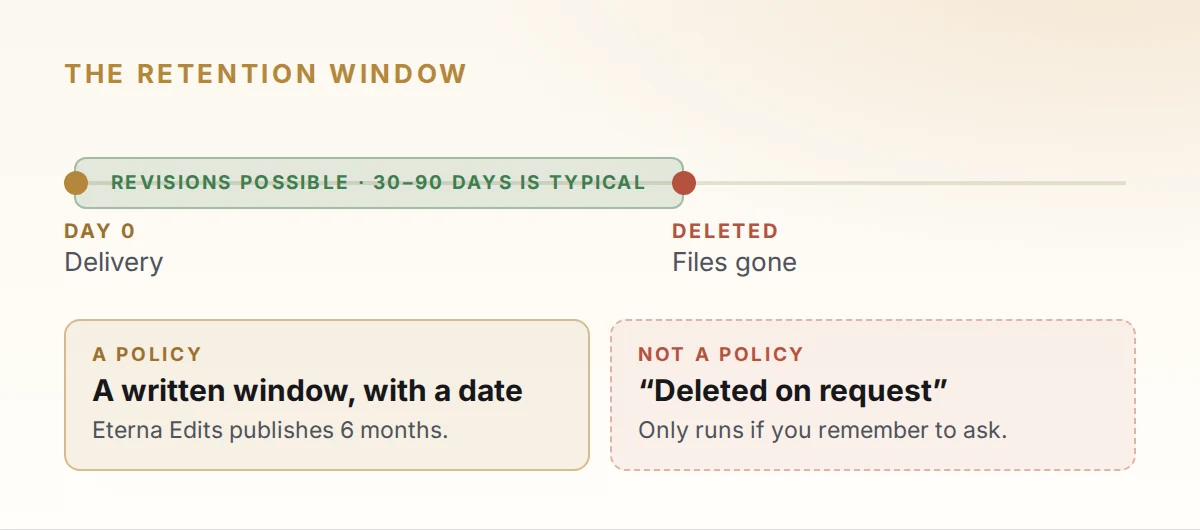
It varies widely, and many editors have no stated policy at all. Common practice is to keep project files for 30 to 90 days after final delivery so revisions are possible, then delete them. Some keep footage for up to a year. The number matters far less than whether it is written down.
There is a real tension here, and it is worth understanding both sides.
You want footage deleted quickly, because every extra copy is extra risk. But you also want your editor to still have the project file when your couple comes back four months later asking for a small change. Delete too early and that revision means re-uploading everything.
So the goal is not the shortest possible window. It is a stated window that you have agreed to and can plan around.
Watch for the phrase “deleted on request.” It sounds accommodating and it quietly moves the work onto you. If deletion only happens when you ask, and you forget to ask — which you will, in September, with eleven weddings still to deliver — then your couple’s footage stays on someone else’s drive indefinitely. A policy with a date attached runs without you.
Eterna Edits publishes its own window in writing: project footage, working files and final outputs are kept for up to six months after a project is completed, then deleted. You can read it on the privacy policy and terms page before you hire anyone. That is the form the answer should take — a number you can check in advance, not a reassurance you get afterwards.
Six months is at the longer end of the range, and deliberately so: it covers a couple coming back late for a revision without you re-uploading a wedding. The point is not that shorter is always better. It is that you should know the number.
Can an editor use your wedding film in their portfolio?
Only if you give written permission, and only if your own contract with the couple allows you to grant it. Portfolio use is the single most common way wedding footage ends up public, and it is almost always done with good intentions rather than bad ones.
This is the clause people forget, because it does not feel like a confidentiality issue. An editor posts a beautiful thirty-second cut to show their color work. No malice at all. But a guest sees it, or the couple sees it, and nobody asked them.
The permission chain has to run the whole way. Your couple permits you. You permit your editor. If any link is missing, the post should not happen — and you are the person standing in the middle of that chain.
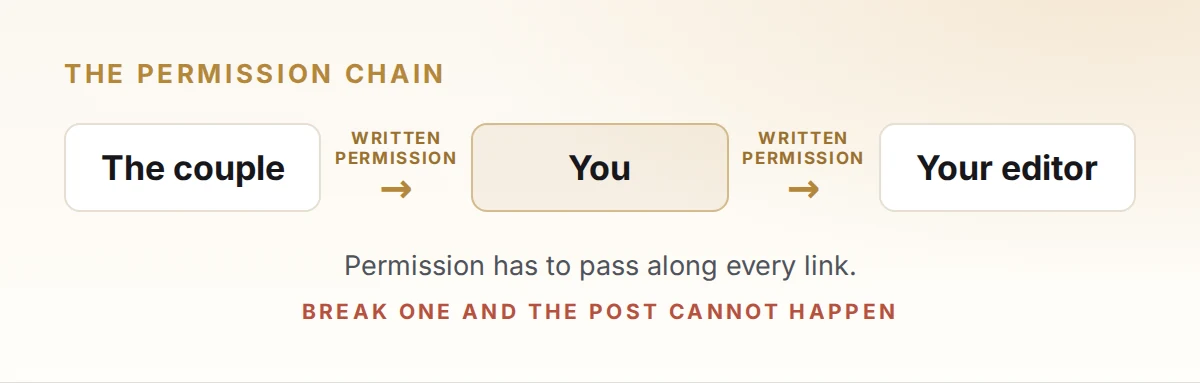
This is not a hypothetical risk. Canada’s federal privacy regulator investigated a case in which a videographer posted a client’s wedding video online without consent, and found the complaint well-founded.1 That decision was made under Canadian law and does not apply in the US, but the underlying situation — footage made public by the professional who filmed it, without asking — is the same one you are trying to prevent.
Get the answer in writing, and make it project-by-project. Blanket portfolio permission signed once at the start of a relationship will eventually cover a wedding you would never have agreed to show.
Do you have to tell your couple you use an editor?
Check your own client contract first. Most wedding videography contracts either permit the use of third-party contractors or say nothing at all. If yours is silent, that is a gap worth closing — and the fix is a single sentence, not a difficult conversation.
Many videographers worry this is an awkward disclosure. In practice it rarely is. Couples are not hiring you because you personally push every button. They are hiring you for the film they end up with.
The practical step is to make sure your contract permits what you actually do. A short clause covering the use of trusted post-production partners under confidentiality obligations does the job. Have a lawyer in your state write or review it — this article is general information, not legal advice, and contract requirements differ by state.
One thing worth being clear on: an NDA between you and your editor does nothing to fix a gap between you and your couple. They are two separate agreements solving two separate problems. If your client contract does not allow outside help, no amount of editor paperwork cures that.
If you want to go deeper on how to set this relationship up well, our guide to outsourcing without losing your signature style covers the briefing and review side of the same decision.
Red flags when you are vetting an editor
Most warning signs are about vagueness rather than refusal. An editor who cannot describe their own file handling has not thought about it, and an editor who has not thought about it cannot protect you.
- “Of course, we’re totally secure” — with no detail when you ask a follow-up. Confidence is not a policy.
- No written privacy or retention policy anywhere on their site. If they have never had to write it down, you are their first person to ask.
- Public, non-expiring download links sent by default. A link anyone can forward is not private.
- Evasiveness about subcontracting. “We have a global team” can mean a lot of things. Ask which.
- “We delete on request” and nothing more. A policy that only runs when you remember to trigger it is not a policy.
- Blanket portfolio rights in their standard terms. Permission should be per project, in writing, from you.
- Reluctance to put any of it in writing. This is the one that should end the conversation. Everything above can be negotiated; this cannot.
None of these mean an editor is dishonest. Most mean they are small, busy, and have never been asked. That is survivable for a corporate client. It is a harder thing to accept for a wedding you only get one chance to deliver.
What a secure handoff looks like, step by step
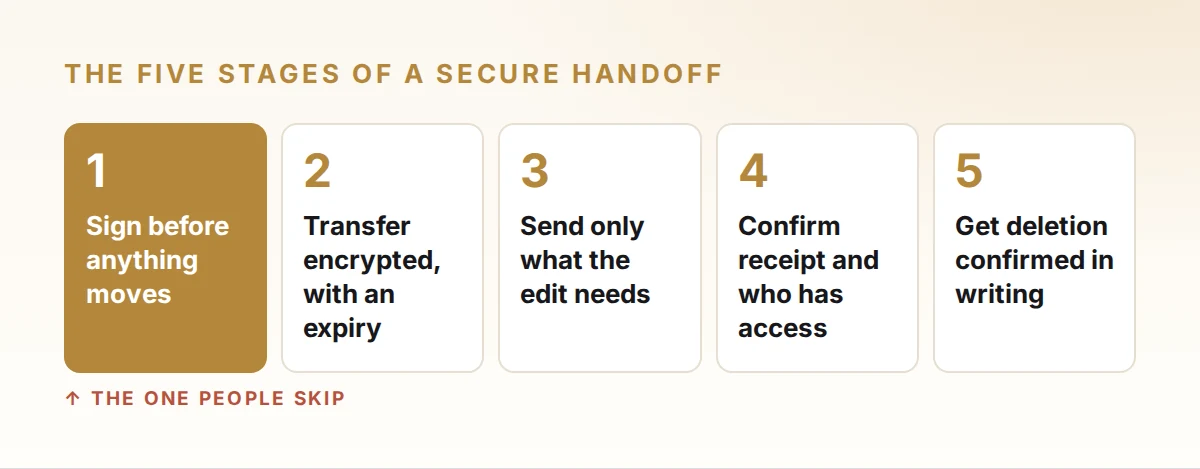
A secure wedding footage handoff has five stages: agree the terms in writing, send over an encrypted link, confirm receipt, limit who can open it during the edit, and confirm deletion after delivery. The whole thing adds a few minutes per project.
-
Sign before you send
The NDA and the answers to the eight questions should both be done before any footage moves. Sending first and papering it afterwards is the most common mistake, and it is the one that leaves you with no leverage.
-
Transfer with a password and an expiry
Use a service that lets you password-protect the link and set it to expire. Send the password through a different channel from the link itself — if both arrive in the same email, the protection is decorative.
-
Send only what the edit needs
If a card holds footage from two weddings, send one. Fewer files in transit means less to go wrong, and it is a habit worth building early.
-
Confirm receipt and access
Ask your editor to confirm they have everything and to restate who now has access. This is a thirty-second email that creates a written record of exactly who held the footage and when.
-
Close the loop after delivery
Once your couple has signed off and the revision window has passed, ask for written confirmation that the footage and project files have been deleted. Keep that confirmation with the project.
Wedding video editing NDA and footage security FAQ
Will a wedding video editor sign an NDA?
Most professional wedding video editors will sign an NDA on request, and many offer one as standard. It costs them nothing and it is a normal part of working with studios. Because it is so easy to agree to, treat a yes as the starting point rather than the reassurance — the useful detail is in how they store, share and delete your footage.
Is an NDA enough to protect my client's wedding footage?
No. An NDA is a legal remedy you use after something has gone wrong, not a safeguard that prevents it. Protection comes from encrypted transfer, expiring links, limiting who can open the files, and a written deletion date. Ask for the NDA, then ask the practical questions underneath it.
Who else sees my footage when I outsource an edit?
Typically your named editor plus anyone involved in preparing or checking the work, such as an assistant or a quality-control reviewer. Some companies also subcontract to freelancers during peak season. Ask who by name or role, ask whether subcontracting happens, and confirm everyone involved is bound by the same confidentiality terms.
How long should an editor keep my wedding footage?
Commonly 30 to 90 days after final delivery, which leaves room for revisions before the files are deleted. Some editors keep footage longer. What matters most is that the window is written down with a date attached, rather than described as "deleted on request", which only happens if you remember to ask.
Can my editor post my wedding film on their social media?
Only with your written permission, and only if your own contract with the couple allows you to give it. Portfolio use is the most common way wedding footage becomes public, and it is usually well-intentioned rather than malicious. Make permission project-by-project rather than a blanket clause signed once.
Do I need to tell my couple that I outsource the editing?
Check your client contract first. Most wedding videography contracts permit the use of third-party contractors, and some say nothing at all. If yours is silent, add a short clause covering trusted post-production partners working under confidentiality obligations. Have a lawyer in your state review it — requirements differ by state.
What is the difference between an NDA and a confidentiality clause?
An NDA is a standalone agreement whose only job is confidentiality. A confidentiality clause is the same duty written into a larger contract, such as a service agreement. Either works for wedding footage confidentiality. What matters is what the wording covers — the raw footage as well as the final film, who may access it, and what happens when the project ends.
What should I do if footage is leaked despite an NDA?
Record what happened with dates and screenshots, ask for immediate removal in writing, and tell your couple before they find it themselves. Then review the agreement for the remedy it sets out. Speak to a lawyer in your state about enforcement — this article is general information and not legal advice.
Why US videographers send their footage to Eterna Edits
Eterna Edits is a white-label wedding video post-production studio working with videographers and studios across the United States. Everything on this page is something you can check before you send us anything — our NDA terms, our retention window and our processing locations are all published on our own terms page, not offered on request.
We answer the eight questions in writing
This post asks you to put eight questions to any editor before you hand over a wedding. It would be a strange article to publish if we could not answer them ourselves, so here they are, in short.
We sign your NDA or provide our own, before footage moves. Your files are opened by the editor assigned to your project and the reviewer who checks the export, with access limited to those people. Transfers are encrypted. We keep project footage, working files and final outputs for up to six months after completion so late revisions are still possible, then they are deleted — and that window is published on our privacy policy and terms page rather than quoted when you ask. We do not post client work without your written permission. Our sales office is in Kalispell, Montana and our post-production studio is in Ahmedabad, India, which is stated on the same page.
What you get back
Cinematic highlight films, short films and documentary edits, cut to match your existing style rather than ours. Films come back under your own brand, so your couple sees your studio and never hears from us. Our prices are published up front — from $249 for a highlight film — instead of being quoted only after a call.
If you would rather compare the market first, our round-up of wedding video editing companies in the USA lists the main studios and what each is good at. If you are weighing whether to outsource at all, we wrote an honest in-house versus outsourced comparison. And if style drift is the thing that worries you most, start with keeping your signature style when you outsource.
Send us one wedding and check the answers yourself
Start with a single film rather than a season. You will see the NDA, the transfer process and the delivery before you commit to anything bigger. If you would rather ask a question first, talk to us — the eight questions above are a perfectly good place to start.
Sources
- Office of the Privacy Commissioner of Canada, PIPEDA Report of Findings #2014-020: Videographer posts client's wedding video on social media without consent. Decided under Canadian law and cited here as a real-world example, not as US legal authority.
EternaEdits Editorial Team
Eterna Edits is a white-label wedding video post-production studio working with videographers and studios across the United States, handling cinematic highlight films, documentary edits, color grading and multicam ceremony work under NDA.
Keep reading