
How to Outsource Wedding Video Editing Without Losing Your Signature Style
You booked those weddings because couples loved the way your films look. Here is the exact method — a written style guide, a reference pack, and a scored test edit — that lets you hand footage to an outside editor and still get your own films back.
EternaEdits Editorial Team · Published September 3, 2026 · 14 min read
You can outsource wedding video editing without losing your signature style if you document that style before the footage leaves your drive. Write a one-page editing style guide, send it with two or three reference films and your color preset, pay for one test edit, and score that test against the guide before you commit a whole season.
- Style is a set of decisions, not a feeling. Pacing, music, color, audio layering and story order can all be written down. If you can’t write yours down, no editor can copy it.
- The style guide comes first. Most videographers look for an editor first and explain the style later. That order is why films come back generic.
- Pay for a test edit, then score it. “Try one wedding” is common advice. Judging that test against fixed criteria is what almost nobody does.
- Ask for one named editor, not a pool. Style drift usually starts the week your work gets handed to a second editor who never saw your reference films.
- Sort out revisions, presets and project files in writing before the first invoice — not in September when you’re behind.
- What your signature style actually is
- Why outsourced films come back generic
- The 7-step process
- Your editing style guide: the field list
- What to send with the footage
- The test edit, and how to score it
- Revisions vs. re-edits
- What white-label editing means
- Stopping style drift across a season
- Who owns your presets and project files
- Warning signs and common mistakes
- Frequently asked questions
What is a wedding videographer's signature style?
Your signature style is the set of repeatable choices you make on every film: how you order the story, how fast you cut, what music you pick, how you grade skin tones, how you use vows and speeches, and how long the finished film runs. It is not one setting or one filter. It is roughly eight decisions you make the same way every time.
That matters, because a decision can be written down. A “vibe” cannot. Once you split your style into these parts, you have something an outside editor can actually follow — and something you can check their work against.
| Part of your style | The choice you make every time |
|---|---|
| Story structure | Do you open with the vows, a wide establishing shot, or a line from a speech? Is the film in real time or does it jump around? |
| Pacing and cut rhythm | Long, held shots that breathe — or quick cuts on the beat. Your average shot length is one of the most recognizable things about your work. |
| Music | The genres you use, the libraries you license from, and whether the edit follows the music or the music supports the speech. |
| Audio layering | How you mix vows, speeches and natural sound (the real sound recorded on the day — birds, laughter, applause) under the music. |
| Color and grade | Warm and filmic, cool and muted, high contrast or soft. Usually carried by a LUT — a color preset file that applies your look in one step. |
| Skin tones | How you handle skin across different lighting and different skin tones. This is where a mismatched grade shows first. |
| Transitions | Straight cuts only, or whip pans, dissolves and speed ramps. Also which ones you never use. |
| Titles and length | Your name card, font, where the couple’s names appear, and the run time you deliver — a 3-minute teaser reads very differently from a 10-minute highlight. |
Run through that table with one of your own films open. Most videographers find they can describe six of the eight in a sentence each, and get stuck on two. Those two are exactly where an outside editor will guess — so those are the ones worth writing down most carefully.
Why do outsourced wedding films come back looking generic?
Films come back generic for four specific reasons, and none of them is that the wedding video editor lacked skill. Almost always, the editor was never given enough information to make your choices instead of their own defaults.
1. Nothing was written down
A phone call and a link to your Instagram is not a brief. The editor watches three films, forms an impression, and fills every gap with their own habits.
2. The reference films were your best, not your typical
Sending your one award-season film sets a bar your normal weddings don’t match. The editor aims at the wrong target and the result feels off.
3. Your work went to a pool of editors
Some services route each job to whoever is free. Film one and film four are edited by different people who never spoke to each other.
4. Feedback was vague
“Make it feel more like us” cannot be acted on. “Cut the prep section from 90 seconds to 45 and hold the vow shot two beats longer” can.
All four are fixable, and all four are fixed by the same thing: writing your style down once, then testing it. That is the rest of this guide.
How to outsource wedding video editing without losing your style
Here is the full process, in the order that works. Do steps 1 and 2 in your off-season, when nothing is on fire. Steps 3 to 5 take a couple of weeks. Steps 6 and 7 run for as long as the relationship lasts.
1
Write your style guide before you contact anyone
One page, covering the eight parts above. This is the single highest-value hour you will spend on outsourcing. The field list in the next section tells you exactly what to put in it.
2
Build a reference pack
Two or three finished films that represent your typical work, your LUT or preset, your title template, and your music sources. Keep it to one shared folder with a plain-text README.
3
Shortlist editors who ask for the brief
Send the same style guide to three or four candidates. The ones who come back with questions about your grade, your audio mix and your run time are the ones to test. The ones who reply “yes we can do cinematic” are not.
4
Pay for a test edit on real footage
Use a real wedding you have already delivered, so you can compare their cut to yours. Pay for it. A free test gets you the vendor’s best editor and their slowest turnaround — neither of which is what you’ll get in July.
5
Score the test against the guide
Not “do I like it?” — score each part of your style separately. The scorecard further down does this in about ten minutes and tells you whether the gaps are fixable.
6
Lock the revision process in writing
Agree how many revision rounds you get, what counts as a revision, how you send notes, and how fast they come back. Do this before the first paid wedding, not during it.
7
Keep one named editor and audit quarterly
Ask for a dedicated editor by name. Every few months, watch three of your recent films back to back and check them against the guide. Style drifts slowly — you only notice it if you look on purpose.
Start in the off-season. The worst time to test a new editing partner is the week you realize you’re eight weddings behind. Testing in January costs you one edit fee. Testing in August costs you a couple’s delivery date.
What goes in a wedding video editing style guide?
A wedding video editing style guide is a one-page document that turns your look into instructions an editor can follow. It is the foundation of real style matching — most advice stops at “make a style guide,” so below is the actual field list, every line worth filling in, with an example of a useful answer next to a useless one.
Write it once. You will reuse it for every editor, every year, and it doubles as the brief for any second shooter or assistant you bring in.
| Field | A useful entry | Not useful |
|---|---|---|
| Film types and run times | Highlight 6–8 min · teaser 60 sec vertical · full ceremony unedited | “Standard package” |
| Opening 15 seconds | Cold open on a vow line over black, then wide of the venue | “Start strong” |
| Story order | Prep → first look → ceremony → speeches → party, chronological, no flashbacks | “Tell the story” |
| Section lengths | Prep max 45 sec · ceremony 2–3 min · speeches 90 sec · party 60 sec | “Keep prep short” |
| Average shot length | 3–5 seconds in emotional sections, 1–2 in the party section | “Not too fast” |
| Music sources | Musicbed and Artlist only · indie folk and cinematic piano · no lyrics under vows | “Something emotional” |
| Music and edit relationship | Cut on the beat in the party section only; everywhere else the speech leads | “Sync to music” |
| Audio mix | Vows and speeches at the front, music ducked about 12 dB under dialogue, natural sound kept in | “Good audio” |
| Color and LUT | Apply the supplied LUT at 80%, lift shadows slightly, keep highlights warm | “Cinematic grade” |
| Skin tones | Natural and slightly warm; never push magenta; match across all cameras and skin tones | “Nice skin” |
| Transitions allowed | Straight cuts and cross-dissolves; one speed ramp per film maximum | “Tasteful transitions” |
| Transitions banned | No whip pans, no light leaks, no zoom punches, no stock overlays | (left blank) |
| Titles and typography | Names at 0:20 in the supplied template; studio card on the last frame only | “Add our logo” |
| Delivery specs | 4K H.264, 24fps, plus a 1080p vertical cut for social | “High quality export” |
| Things you never do | No slow motion on the vows · no drone in the ceremony · no music over the first kiss | (left blank) |
The last row matters more than people expect. Editors can guess at what you like. They cannot guess at what you’d hate. A short “never do this” list prevents most of the revisions you’d otherwise spend a week on.
Wedding Edit Style Guide
Vow line over black, then a wide venue shot.
Prep → first look → ceremony → speeches → party.
3–5 sec in emotional sections; 1–2 sec during the party.
Supplied LUT at 80%; lifted shadows; warm highlights.
Dialogue leads; music ducks under vows; natural sound stays.
Light leaks, zoom punches, stock overlays or whip pans.
Example only — replace these fields with the studio’s real, anonymized instructions before publishing.
What should you send an editor besides the footage?
Send five things with every job: your style guide, two or three typical reference films, your LUT or preset file, your title template, and a short note about that specific wedding. Together these are your reference pack, and they cut the first-draft revision load dramatically.
- The style guide — the one-pager from the section above. Same document every time, so the editor learns it.
- Two or three reference films — your typical work, not just your best. Say why each one is a good example: “this one for pacing, this one for the grade.”
- Your LUT or preset — the actual file, with a note on how strongly to apply it. Handing over the file is far more reliable than describing the look in words.
- Your title and logo template — a project file or graphics pack, plus the font. Fonts are the single most common thing people forget to send.
- A wedding-specific note — anything unusual about this couple or this day. A parent who has since passed away, a surprise performance, a ceremony in two languages, a moment you promised the couple you’d include.
Also send your footage organized the same way every time. Consistent folder names for each camera, audio recorder and drone save the editor an hour of guessing per wedding, and they make it far easier for a second editor to pick up your work later.
One reference film is not enough. A single film tells the editor what you did once. Two or three tell them what you do consistently — which is the actual definition of a signature style.
How do you test an editor before trusting them with a season?
Give the candidate a wedding you have already edited yourself, send the full reference pack, and pay for one highlight film. Then score their cut against your style guide, part by part. Comparing their version to your own version of the same footage is the fastest, fairest test there is.
Almost every guide tells you to run a test edit. Very few tell you how to judge one — so people watch it once, feel vaguely unsatisfied, and can’t say why. Score it instead.
| What to check | Score 2 if… | Fixable? |
|---|---|---|
| Story order | The sections run in your order, with your opening | Yes — it’s an instruction |
| Section lengths | Each section is within about 20% of your stated length | Yes |
| Pacing | Shot lengths feel like yours in both the quiet and the fast sections | Sometimes — this is instinct as much as instruction |
| Music choice | The track could plausibly have come from one of your own films | Yes |
| Music and edit sync | Cuts land where you’d land them relative to the track | Sometimes |
| Color match | Held next to your own film, the grade reads as the same studio | Yes — usually a LUT strength issue |
| Skin tones | Skin looks natural across every camera and every guest | Yes, if they have the skill |
| Audio mix | Vows and speeches are clear, music sits under them, natural sound survives | Yes |
| Transitions | Only your allowed transitions appear, and none of your banned ones | Yes — pure instruction-following |
| Instruction-following | Nothing on your “never do this” list appears anywhere | This is the real test |
Read the “fixable” column carefully. A weak color match is a settings conversation and takes one round to fix. A film that broke three rules on your “never do this” list is a different problem: that editor didn’t read the brief, and they won’t read it in July either.
Give the same footage and the same brief to every candidate. It’s the only way to compare them fairly — and the differences between their cuts will teach you which parts of your own style guide are still too vague.
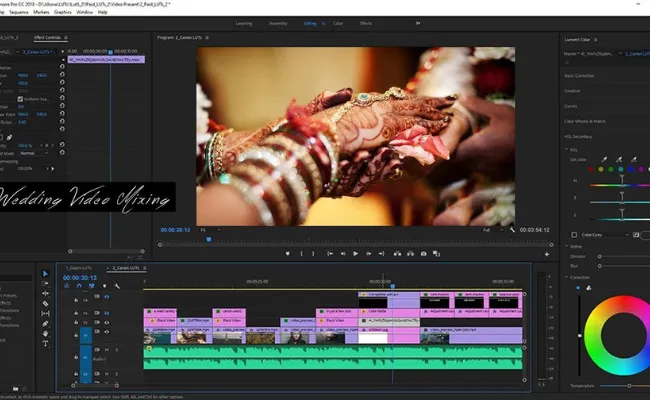
A consistent test uses the same footage, the same brief and the same scorecard for every candidate.
How many revisions should you expect — and what counts as one?
Two to three revision rounds per film is the industry norm, and most wedding editing companies include them in the base price. The part worth agreeing in writing is what counts as a revision versus a re-edit, because that line is where most disputes and most delays happen.
| Usually a revision (included) | Usually a re-edit (billed extra) |
|---|---|
| Swapping a shot for a better take | Changing the music track after the film is cut |
| Trimming or extending a section | Restructuring the whole story order |
| Adjusting the grade or a specific shot’s color | Changing the target run time by several minutes |
| Fixing an audio level or a name spelling | Adding a deliverable that wasn’t in the brief |
| Removing a transition you didn’t want | Re-cutting from a different set of footage |
Changing the music after the edit is locked is the classic example. It looks like a small request — but the cut points were built around the old track, so almost every edit in the film has to move. Deciding the music before the first cut saves more time than any other single habit.
Send notes with timecodes. “At 1:42, hold this shot two seconds longer” gets fixed in one pass. “The middle feels slow” gets fixed in three.
What is white-label wedding video editing?
White-label wedding video editing means an outside team edits your films under your brand, with no mention of them anywhere. The couple sees your studio name, your titles and your logo. As far as your client is concerned, you edited it — because in every way that matters to them, your studio did.
For a videographer worried about their signature style, white-label matters for two practical reasons:
- Your branding stays intact. Your title template and end card go on the film, not someone else’s — brand consistency from the first frame to the last.
- The relationship stays yours. A white-label partner doesn’t contact your couples or market to them.
It’s worth being clear about what white-label does not do: it doesn’t make an editor match your style. Those are separate things. Plenty of white-label services will happily put your logo on a film that looks nothing like your work. The style guide and the test edit are what protect the look; white-label just protects the label.
If you’re weighing this up against hiring in-house, our comparison of in-house vs. outsourced wedding video editing for studios covers the cost and capacity side in more detail.
How do you stop style drift across a full season?
Style drift is when your films slowly stop looking like each other. It rarely happens in one bad edit. It happens across a season as small compromises stack up — a different editor here, an unrepeated note there — until January’s films and September’s films look like two different studios made them. For a wedding videographer whose bookings depend on a recognizable look, this is the real long-term risk of outsourcing, and it is the one nobody warns you about.
Four habits prevent it:
- Insist on one named editor. Ask directly: “Who edits my films, and will it be the same person every time?” A vague answer is your answer.
- Update the style guide, not just the email thread. When you change your mind about something, edit the document. Otherwise the fix only exists in one conversation the next editor never sees.
- Keep a “current look” reference. Every few months, replace your oldest reference film with a recent one you’re happy with. Your style evolves; the pack should too.
- Do a quarterly drift check. Watch three recent films back to back and check them against the guide. Fifteen minutes, four times a year.
Watch for the handover. If your regular editor is on leave, ask what happens to your work. The answer should be “we tell you, and the cover editor gets your full pack” — not silence and a film that arrives feeling slightly off.
Who owns your LUTs, presets and project files?
Agree this before you send anything. You are handing over the files that define your look, so three things need to be written down: that your presets stay confidential, that finished films and project files belong to you, and that you get the project files on request.
- Your LUTs and presets. These are the most copyable part of your brand. A confidentiality agreement or NDA covering your assets — not just the footage — should be standard.
- Project files. Ask for the editable project file, not just the export. Without it, a small fix two years later means re-editing from scratch, and moving to a different editor becomes painful.
- The footage itself. Confirm how long they retain it, how it’s stored, and how it’s deleted. Wedding footage is personal, and some of your couples will care a great deal about this.
Warning signs you picked the wrong editing partner
Most of these show up in the first two weeks, well before a couple is affected — if you know to look for them.
- They never asked for a brief. An editor who doesn’t want your style guide is planning to use their own defaults.
- They won’t name your editor. “Our team handles it” means a pool, and a pool means drift.
- The test edit broke your “never do this” list. That’s a reading problem, not a skill problem, and it repeats.
- Notes need repeating. If the same correction comes back twice, it will come back a third time when you’re busiest.
- Slow, vague communication. An editor who goes quiet for ten days during a calm month will not be reachable in peak season.
- They resist a written revision policy. Anyone unwilling to define a revision in writing is leaving themselves room to bill for one.
The three mistakes that actually cost people their style
- Choosing on price alone. The cheapest quote usually assumes a template edit with minimal revisions. That’s exactly the deal that produces generic films.
- Skipping the style guide because you’re behind. Understandable, and it’s the reason the first three films come back wrong — which puts you further behind.
- Expecting a perfect match on film one. Even a good partner needs two or three weddings to internalize your look. Judge the trend across three films, not the first draft of one.
Want an editing partner that works to your style guide?
EternaEdits is a white-label wedding post-production studio. We start every studio relationship the way this guide describes: your style guide and reference pack first, a test edit second, one named editor after that. Send us your reference films and we’ll tell you honestly whether we can match your look.
If you’d like to see how style matching works on a real project, our case study on matching a client’s wedding editing style walks through the reference films, the grade and the revision notes on an actual wedding. For the wider outsourcing decision — cost, timing and what can be handed over — see our guide to outsourcing wedding video editing for US videographers.
Frequently asked questions
Can I really outsource wedding video editing without losing my style?
Yes, provided your style is documented before you outsource. Editors can reproduce pacing, grade, music approach and story structure reliably when they’re given a written style guide, reference films and your color preset. What they cannot do is reverse-engineer a style from three Instagram clips and a phone call.
How long does it take an outside editor to match my style?
Expect two to three weddings before the match feels automatic. The first film usually needs the most revision notes, the second noticeably fewer, and by the third a good editor is anticipating your preferences. If revisions aren’t dropping by film three, the problem is either the brief or the editor.
What is a LUT, and should I send mine to an editor?
A LUT (look-up table) is a color preset file that applies your grade in one step. Yes, send it — describing a look in words is far less reliable than handing over the file. Send it under a confidentiality agreement, and tell the editor how strongly to apply it, since most LUTs are used at reduced strength rather than at 100%.
Should I pay for a test edit?
Yes. A free test tends to get the vendor’s strongest editor and unusual care, which isn’t what you’ll receive in peak season. A paid test on real footage you’ve already edited yourself gives you a fair comparison and shows the vendor you’re a serious prospect.
Will my couples know their film was edited by someone else?
Not with a white-label service. White-label wedding video editing means the film carries your branding and titles only, and the editing partner never contacts your clients. The relationship, the delivery and the credit all stay with your studio.
How many revisions should be included?
Two to three rounds per film is standard across wedding editing companies. More important than the number is the definition: agree in writing what counts as a revision (swapping a shot, trimming a section, adjusting the grade) versus a chargeable re-edit (changing the music after the cut is locked, restructuring the whole story).
How do I stop different editors making my films look different?
Ask for one named editor rather than a pool, keep your style guide updated as a document instead of scattered across email threads, refresh your reference films every few months, and watch three recent films back to back once a quarter to catch drift early.
Do I get the project files, or just the finished video?
Ask for both, and get it in writing. Without the editable project file, a small change two years later means starting over, and switching editors becomes far harder.
When in the year should I start outsourcing?
In your off-season. Writing the style guide, shortlisting editors and running a scored test edit takes a few weeks of calm attention. Starting the process when you’re already behind is what forces the shortcuts — skipping the guide, skipping the test — that cause films to come back generic.
- Shootsta — Keeping brand consistency across outsourced video editing (on baking brand rules into templates rather than documents)
- Rock n Roll Bride — A wedding filmmaker’s guide to outsourcing (on testing candidates in the quiet season with identical footage and briefs)
- Bride&Groom.video — Wedding LUTs explained (background on color presets and building a consistent look)
E
EternaEdits Editorial Team
EternaEdits is a white-label wedding and video post-production studio working with videographers and studios in the United States. Our editors work to client-supplied style guides across cinematic wedding editing, color grading and multi-camera delivery.